“No man ever steps in the same river twice, for it’s not the same river and he’s not the same man.”
Heraclitus
Meaning
This quote reflects on the nature of change and impermanence. Heraclitus believed that the universe is in a constant state of flux and that everything is continuously changing. The river metaphor illustrates this concept beautifully: every time you step into a river, the water that touches you is different, and you too are different in some way, whether physically, mentally, or emotionally.
Heraclitus
- Heraclitus was an ancient Greek philosopher, born around 535 BC in Ephesus, then part of the Persian Empire.
- He is often referred to as the “Philosopher of Change” due to his doctrine that change is the fundamental essence of the universe.
- Heraclitus believed in the unity of opposites, stating that opposite forces are interconnected and that they constantly undergo a process of transformation. For example, life and death, day and night, are seen as part of a continuous cycle.
- He famously stated that “Everything flows, nothing stands still,” highlighting his belief in perpetual change.
- Heraclitus’ work was mostly compiled in a book known as “On Nature,” but it survives only in fragments quoted by other authors.
- His philosophical insights significantly influenced later philosophers and various philosophical schools, including Stoicism.
About the art
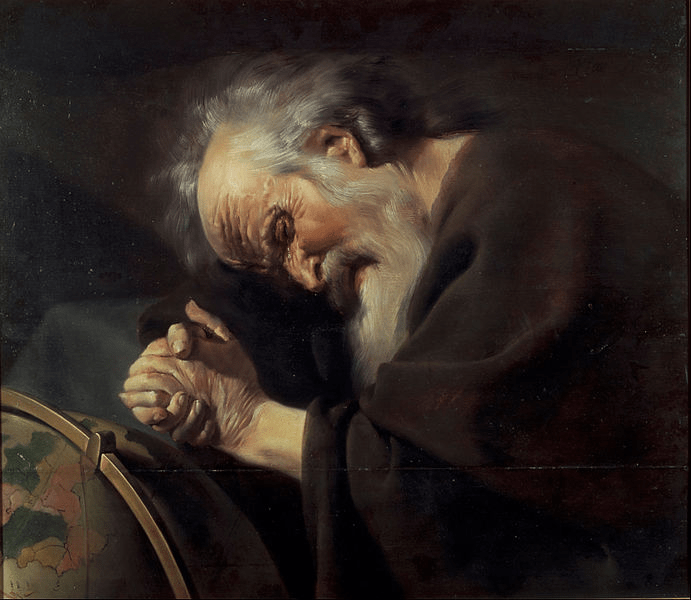
Due to their opposing views of humanity, the Greek philosophers Heraclitus and Democritus are often depicted together. Even in antiquity, Heraclitus was known as ‘the weeping philosopher’, who lamented the human lot – whereas Democritus could only laugh at its absurdity. In the 17th century, the transience of man, Vanitas Mundi, was a popular theme. The two philosophers with the globe – the symbol of humanity – express a simple message: whether you laugh or cry, it makes no difference to our existence.
Painted by Johannes Paulus Moreelse (1603-1634), or Johan Pauwelszon Moreelse, who was a Dutch baroque painter belonging to the school of Utrecht Caravaggism during the Dutch Golden Age.
Moreelse was born in Utrecht, Holland. His father, Paulus Moreelse, was at that time a famous portrait painter. Little is known about his life. Johan Moreelse studied in Utrecht, in the studio of his father, and then in Rome (1627), where he was appointed into a papal knight order. Moreelse died in his home town during a plague epidemic. His small number of known works were only assigned to him in the 1970s.
 RICHARD WILSON